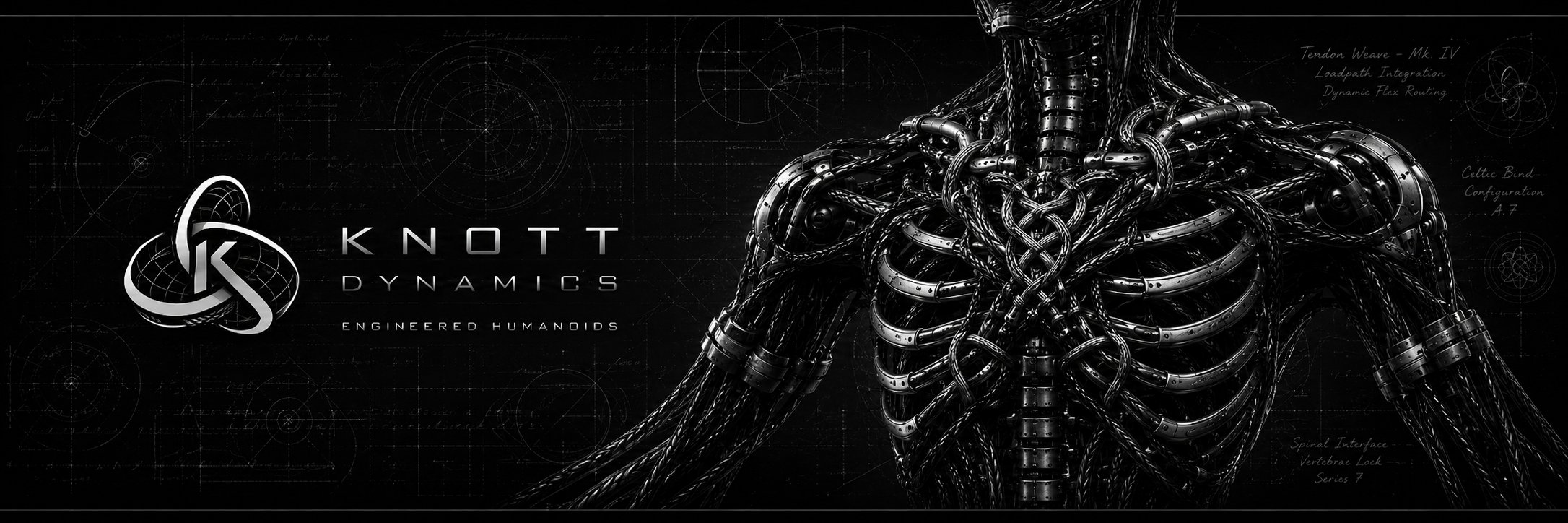
New developments in actuators are enabling faster, more precise movements in humanoid robots.
The actuator is the soul of a humanoid. Every joint, every grasp, every gesture is a story told through the language of torque, back-EMF, and thermal mass. This post walks through three advances that define our current generation.
1. The Series-Elastic Vertebral Stack
Our latest spinal assembly uses 28 stacked vertebrae, each a precision-machined titanium cartridge with embedded strain gauges. The result is a backbone that is simultaneously rigid enough to hold a 14kg payload at full extension and compliant enough to absorb a 6kN impact without damage.
Specifications
- Peak torque density: 187 N.m/kg
- Backlash: < 0.3 arc-min
- Cycle life: 50M full-load cycles
2. Closed-Loop Tendon Tension
Traditional tendon-driven joints suffer from tension drift - the cables stretch, the joint slacks, and the calibration silently rots. Our closed-loop tensioner uses a load cell at every anchor point and adjusts in real time.
A humanoid is only as precise as its loosest cable.
3. The Celtic Bind
Our patented three-strand Celtic Bind architecture routes redundant tendons through a continuous loop, so that no single cut can disable a limb. The pattern is older than robotics - and stronger than any test fixture we have built.
What This Means in Practice
A KD-07 with a severed primary tendon on its right arm can still lift 62% of rated payload on that arm alone. The bind is not redundancy. The bind is graceful degradation.