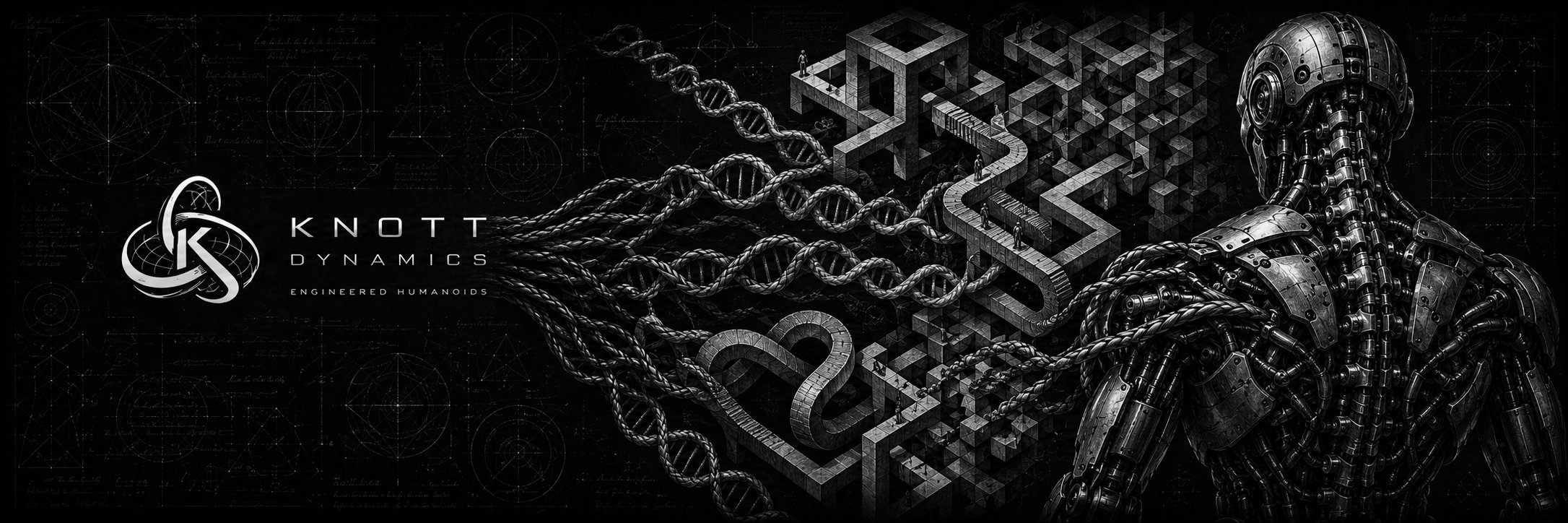
A deep dive into the technical specifications of our newest humanoid robot platform.
When we set out to design the latest generation platform, we started with a single constraint: no single point of failure in the entire kinematic chain. Every other decision - material, topology, control law - flowed from that.
The Tendon Weave
Our fourth-generation tendon weave uses a three-strand continuous braid routed through a CNC-machined titanium anchor grid. Each strand is rated for 1.5x the joint's peak load. The result is a limb that is structurally over-determined - a property engineers usually avoid, and one we have learned to depend on.
Materials
- Outer sheath: Dyneema DM20, 0.4mm wall
- Core strands: Vectran HS, 12k denier
- Anchors: Ti-6Al-4V, machined and HIP'd
DNA Helix Power Bus
Power is the silent killer of any humanoid. We solved it with a double-helix bus that runs the length of the limb - two counter-wound conductors that share return current and cancel their own magnetic field.
Twist the bus, and the bus disappears from the world around it.
Control Stack
The control stack runs on a custom RISC-V vector processor at 1kHz inner loop, with a perception layer at 120Hz on a discrete NPU. The two are coupled through a model-predictive whole-body controller that solves the full dynamics problem at every tick.
Performance
- End-effector repeatability: +- 12 um
- Whole-body controller solve time: 0.7 ms
- Mean time between unscheduled stops: 4,200 hr
What Is Not On The Datasheet
The number that matters most is the one we do not publish: how it feels to work alongside it. We measure that. The number is good. It is getting better.